With the season of over-indulgence for many of us fast approaching, I thought I’d look at an aspect of pet diets that could be controversial, and that is “Could/should our pets be vegan?”
This topic is probably best tackled by species, but just cats & dogs for now!
Cats: This is an easy start, and the answer is NO! Cats should never be vegan. Cats are obligate carnivores, i.e. they require nutrients that are only found in animal tissue, such as taurine and preformed Vitamin A. Cats need sufficient levels of B1 (Thiamine) too, which would be extremely difficult to meet if they were vegetarian or vegan.
A lack of these nutrients can lead to serious illness, from life threatening conditions such as blindness, heart disease, neurological problems and malnutrition; through to skin irritations and a lacklustre coat.
Interestingly, cats fed a high amount of raw fish can also develop Thiamine deficiency (Vitamin B1), as raw fish contains an enzyme that breaks down Thiamine. B1 deficiency can lead to neurological dysfunction and muscle weakness and is often characterised by a drooping head, as their neck muscles become weakened.
Cats who are fed too much raw liver can develop Hypervitaminosis A which leads to a rigid and extended head/neck posture.
You might see vegan cat food for sale stating that it is supplemented with synthetic nutrients, but we don’t know if these can be properly absorbed by cats, so are best avoided.
Dogs: In theory, yes, dogs could be vegan. Unlike cats, dogs are technically omnivores, but to transition to a vegan diet would require extremely careful consideration, and preferably the involvement of your vet or vet nurse with an extra qualification in nutrition, to ensure that the diet fed was well balanced and nutritionally complete.
It could potentially be worth exploring if your dog was proven to be allergic to animal proteins, but plant-based food is likely to be harder to digest, which could lead to gastrointestinal issues.
We have certainly messed around with dogs’ DNA over the centuries, with experimental breeding and cross breeding, but you still only have to look at most dogs’ dentition to see how well adapted they are for a carnivorous diet, with their comparatively large canines for killing prey and tearing flesh, and their strong carnassial teeth at the back for crushing bone, along with their strong jaws.
Although dogs are technically omnivores as stated earlier, they may be better referred to as ‘carnivorous omnivores’ or ‘scavenger carnivores’. Their jaws lack the ability to move from side to side as seen in herbivores and other omnivores, instead they chop up and down which is ideal for gulping down large chunks of meat! They also lack the enzyme Amylase in their saliva, which is needed to begin breaking down starches in plant material, so their digestive system is truly optimised for meat.
Humans also have teeth that can cope well with meat, and we are true omnivores, but if we decide to be vegetarian or vegan then that is purely our decision, and we can react to cravings our body sends us… for example I’m convinced that my recent convert from Marmite-avoider to a Marmite-in-my-sandwiches-every-day-person was my body telling me to get some Vitamin B12!
I think, as with any dietary fads and fashions, we must look at the science, and consider who we are really doing this for, ourselves or our companion animals? And will it keep our pets both happy and healthy?
For further reading, please see: https://www.bva.co.uk/news-and-blog/blog-article/is-it-safe-to-feed-my-dog-a-plant-based-diet-hold-the-greens-only-meals-why-the-jury-is-still-out-on-vegan-dog-diets/
And here’s a light-hearted comment found on AI:
This is a deer – a classic herbivore. It is eating meat:

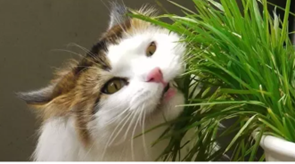
This is a cat, an obligate carnivore that will die if not fed meat. It is eating a plant:
This is a dog, it is a carnivore. It is eating pizza:

