Author: Our Special Friends

Why we have National Awareness Days, Weeks & Months

Many awareness months remind us to be conscious of the circumstances of others and to encourage us to celebrate some of the values that are meaningful in our lives. For Our Special Friends, they enable us to raise awareness and help us to explain why there is a need for the animal companionship support services we provide.

In April we celebrated National Pet Month which aims to raise awareness around responsible pet ownership through educational campaigns and by offering resources across various platforms. National Pet Month celebrates pet ownership, sharing the many benefits of our cherished companions across the UK. This is a message that Our Special Friends endorses all year round. We often find that if the welfare of a pet is being neglected it can be the first indication to the outside world that there is a problem at home. Animals suffer from stress too, and it can have an equally devastating impact on their health and their behaviour. Our Special Friends aims to gently get to the root of the problem, and put the necessary steps in place find a solution for everyone involved, including the animal.

April also saw Stress Awareness Month. Stress can manifest itself in all sorts of ways both mentally and physically and sometimes with devastating effects to people (and the animals around them). Our Special Friends aims to support this, and other forms of vulnerability, where the relationship of a person and their companion animal is compromised.

We see many clients who need help to cope because, without our intervention, they find it difficult to recognise and get the help they need. We do this by alleviating the immediacy of the problem, by sorting out ‘fostering to reunite’ or dog walking for example, and then we connect them with people or practitioners to provide a more long-term solution. The aim being to preserve the relationship that is so important to their wellbeing. Not only the wellbeing of the client, but also that of their companion animal. Sadly, sometimes it is the relationship that is detrimental to the animal’s welfare as we often see when a stressful home environment is impacting negatively on the family’s pet.

The Stress Management Society offer free advice and support for people who are trying to alleviate the stress from their lives. From online workshops and events, individual stress tests, and guides to recognising stress and putting together a long-term plan to reduce it.

Gemma’s story… from volunteer to Animal Companionship Practitioner with Our Special Friends

It is Veterinary Nurse appreciation month so we thought it would be nice to feature a volunteer story from Gemma, our Animal Companionship Practitioner and veterinary nurse.


I first became aware of Our Special Friends (OSF) at an event in 2018 that I attended with my dad and his dog.  We stopped to have a chat with Belinda (Bin) and I quickly realised that hers was a very exciting Charity that filled numerous gaps between social and animal care.

I was working as a self-employed locum Registered Veterinary Nurse (RVN) at the time which meant I had a little flexibility in my working week, so I asked about Volunteering.  Although I already knew that I’d like to work for OSF, there were no vacancies at the time.

My RVN skills were put to good use in the first case I helped with, cleaning ears and applying eye drops to a lovely little Cavalier King Charles Spaniel called SETH, before taking him for a walk.  I did this several times a week on my way to or from working at the Cambridge Cat Clinic, so I got both my dog and cat fix on those days!  Another case I helped with was visiting an elderly Border Terrier called DAISY, to help her also-elderly owner plan for their futures.  Advanced Care Planning, i.e. “what will happen to my pet should something happen to me” is something that gets overlooked by some animal owners, and is one of the many vital services that OSF helps provide.  Thanks to OSF I also learnt how to conduct a Client Assessment, and I did a couple of days in the office too which was then based at Bin’s house.  My main memory of this is Bil (office Admin) being so welcoming and putting me on the tea rota even though I was only there very occasionally!

“I’m very proud to be part of Our Special Friends, making a difference.”

Being a locum RVN was good in the main, but challenging, having to adapt to different places and their varying standards and ways of working, and in the end I longed for more routine and stability, so I took up employment at Haverhill Vets4Pets.  

Although there are many great things about being a Veterinary Nurse, it is pretty physically and emotionally demanding, and I’d long wanted a change, so I was absolutely thrilled when I was offered the newly created role of Animal Companionship Practitioner at OSF.  As it turns out, this role can also be very emotionally demanding, but at least I get to sit down ha ha!  

The pandemic had such an impact on the Veterinary industry and completely changed the way we worked.  The concurrent boom in people getting pets, often rather spontaneously, coupled with redundancies and widespread lack of income was the straw that broke this camel’s back, and I wanted desperately to make a move to the side of people and animal care that was able to provide some sort of help in these circumstances.  

Working for Our Special Friends is amazing. I get the variety that I loved in Vet Nursing, as you never know exactly what the day is going to hold, but we also get to help people whose lives are often extremely difficult.  The common theme is the Client’s love for their animals, and whether we’re helping them stay together by providing dog walking or Veterinary care, or if we’re matching them with a Volunteer who visits with their dog (or cat on occasion!) we are all striving to improve the lives of both the people and their animals together.  

“I have also been blown away by the enthusiasm and dedication of the Volunteers, a fantastic bunch of people who really do go above and beyond what is initially asked of them.”

It has all taken a bit of a mind-shift on my part after nearly 30 years of being animal centric, and there has been an awful lot to learn about the complexities of social care – but who knows I may get there by the time I retire!?  What I’m certain of is that it’s never boring, it’s sometimes very sad but frequently extremely rewarding, and I’m very proud to be part of Our Special Friends, making a difference.


To find out more about British Veterinary Nursing please visit bvna.org.uk/.

Adam wanted to give something back…

Adam’s sister contacted us when her brother was admitted into hospital as an emergency after a car accident. She was working full time and already had two dogs in the house. She had a dog walker who could cope with walking two dogs, but not three. The dog, Luke, needed to be with someone full time because he suffered separation anxiety and barked if left alone.

We put a call out, and found an elderly lady who could temporarily foster Luke during Adam’s stay in hospital. Adam’s family delivered Luke to his temporary foster home and Our Special Friends visited the next day to see how he was settling in, check his microchip details and put a temporary ID disc on his collar.

It was quite an ordeal for Adam, but the knowledge that his dog, Luke, was being well looked after was reassuring for him whilst he recovered from, what turned out to be, quite a nasty car accident.
He was eager to pick Luke up as soon as he was discharged from hospital. The lady who looked after him said that she was pleased to be able to help and it was lovely to feel needed. Her husband had recently moved into a home and she was feeling quite lonely on her own at home.

Quite a few months after his ordeal, Adam realised that in his eagerness to get home, he felt he hadn’t really thanked Luke’s fosterer and Our Special Friends as much as he would have liked. He contacted us directly and asked if he could speak to the lady who fostered Luke so that he could thank her in person.

Shortly afterwards, he decided he would make a concerted effort to raise some funds for Our Special Friends and decided to run the Cambridge Half Marathon. Not content with that, he also put on a Quiz night the very evening before the half marathon. Together he raised an
amazing £1,100 for Our Special Friends for which we are immensely grateful.


Quiz night with Luke on stage


Why we have National Awareness Days

These awareness months help as a reminder for us to be conscious of the circumstances of others.

Stress can manifest itself in all sorts of ways both mentally and physically and sometimes with devastating effects to people (and the people around them). Our Special Friends aims to support this, and other forms of vulnerability, where the relationship of a person and their companion animal is compromised. We see many clients who need help to cope because without our intervention they find it difficult to recognise and get the help they need. We do this by alleviating the immediacy of the problem, by sorting out ‘fostering to reunite’ or dog walking for example, and then we connect them with people or practitioners to provide a more long-term solution. The aim being to preserve the relationship that is so important to their wellbeing. Not only the wellbeing of the client, but also that of their companion animal.

During this month the Stress Management Society offer free advice and support for people who are trying to alleviate the stress from their lives. From online workshops and events, individual stress tests, and guides to recognising stress and putting together a long-term plan to reduce it.

In April we also celebrate National Pet Month which aims to raise awareness around responsible pet ownership through educational campaigns and by offering resources across various platforms. National Pet Month celebrates pet ownership, sharing the many benefits of our cherished companions across the UK. This is a message that Our Special Friends endorses all year round. We often find that if the welfare of a pet is being neglected it can be the first indication to the outside world that there is a problem at home. Animals suffer from stress too, and it can have an equally devastating impact on their health and their behaviour. Our Special Friends aims to gently get to the route of the problem, and put the necessary steps in place find a resolve for everyone involved, including the animal.

Let’s make a noise about National Awareness Months on social media, after all the best way to raise awareness is by word of mouth! #NationalPetMonth #StressAwarenessMonth

Sophie is finding her volunteering so rewarding… 

I first started volunteering for Our Special Friends in 2021, when I was no longer attending my local animal sanctuary due to the coronavirus pandemic. Since then, I have walked 2 dogs for the charity, and formed a wonderful relationship with both. Having volunteered for a year now, I hope to continue with this well into the future.

The first dog I began walking was a little terrier named Benny. It was a little daunting going into someone’s home while they weren’t there to walk their dog, but Benny soon made me feel right at home; he’s always so pleased to greet the volunteers and go out for a walk. Building a relationship with him on trust and love has been an amazing experience, and our friendship is very dear to me. I’m not sure if I’m more pleased to see him or if he’s more pleased to see me when I visit!

Following Benny, I am now walking a very rambunctious Alaskan malamute named Storm. Storm is still a puppy at only 9 months old, so it is great to be a part of her growing and learning to help to shape her into a wonderful companion. To see her engagement with me grow over the time we have spent together has been incredible, and I am excited to continue to build this and to support her owner, who is recovering from surgery.

More than just the animals, volunteering for Our Special Friends is also about helping the people. Supporting Benny and Storm has meant not only that their needs are met, but also that their owners are able to attend hospital appointments and recover from surgery without worry. It is fantastic to be entrusted with these very special animals and to support their wonderful humans.

Financial Report

Legacy Leaflet

Annual Report 2020-2021

At the beginning of 2020 none of us could have imagined the impact the COVID-19 would have on our lives and the devastation that it would leave across our planet. Throughout the pandemic Our Special Friends continued our work of helping and supporting people at some of the most vulnerable times in their lives.

Our Special Friends Leaflet

Promoting, preserving and providing the power of animal companionship.

We are a Suffolk based charity which has frown out of a desire to support people who are struggling in a range of situations where animal companionship plays an important role in helping them cope. We believe in promoting, preserving and providing the power of animal companionship.

On the Topic – Animal Assisted Intervention (AAI)

Animal-Assisted Intervention (AAI) is becoming more widely known and is a key element of One Health One Welfare – a collaborative and holistic approach to supporting human, animal and environmental wellbeing together. The benefits to bringing the joy of animal companionship, through a volunteer visit, are profound. Our Special Friend’s Animal-Assisted Activity (AAA) project is a creative solution which improves mental health for lonely and isolated people who love animals but are unable to care for a pet of their own, usually due to advancing age, ill-health, or disability.  It can be particularly challenging for people who have kept pets for the majority of their lives to suddenly have such a void, leaving them isolated and depressed.  Absence of animal companionship can compound mental health issues, especially as the majority of our AAA clients live alone, without family nearby and a decreased or non-existent social circle.

Through AAA, volunteers and their pets (predominantly dogs) make weekly visits to clients in their own home to provide animal companionship and vital human social interaction.  Where clients have sufficient mobility, they may walk the dog together with the volunteer – referred to as accompanied walking.  Not only does the client receive the proven benefits to mental health of contact with an animal, they also gain vital human social interaction with the volunteer.  OSF carefully matches clients with volunteers so, where possible, they live in the same or nearby communities to increase the opportunities of wider social interactions and community engagement to further enhance mental health.

An AAA visit can enhance the quality of life and give our clients something to look forward to. Often carers visits are short, with many demands to ‘get dressed, take medication and eat…‘ and not much time to just enjoy some company. In so many cases, an AAA visit is the only time where someone visits purely just for a chat and time with an animal, with no expectation to DO anything. No two visits are the same; some will find an activity to do together and others involve sitting comfortably and quietly together, with the animal doing all the ‘talking’. Volunteer visits can also help identify any unmet needs or issues. We encourage all volunteers to communicate any concerns to the office and we can notify the appropriate teams to organise the right support.

During the AAI training session, we discussed some top tips for visiting and how to plan to avoid anything going ‘wrong’. Here are some highlights;

  • Consider the Environment. Are there any breakables at ‘dog level? Is medication out of reach and no snacks left on the side that an opportunistic dog may take a liking to.
  • What to bring. An allocated number of treats can bring structure to a visit (and avoid weight creeping up). It is a good idea to bring a towel or blanket to help protect clothing and skin (particularly if your client would like a doggy companion on their lap). And, of course, be sure to bring water and a bowl too.
  • What to do: The nature of your relationship with the client, dog, and volunteer is likely to evolve naturally. It is nice to explore any activities. This could include doing the crossword, enrichment activities with the animal, a short walk (if deemed safe), etc. We would love to hear of your innovative ideas and share them with our volunteers.
  • When to stop: Whilst your client might be enjoying their visit it is absolutely fundamental that volunteers are aware if/when their animal is uncomfortable. Some stress signs are obvious such as cowering and shaking, but others are subtle. Please see the below link for more information on subtitles signs as well as Trigger Stacking.

Make Every Contact count Training

Jan enjoying her responsibilities at Our Special Friends

Jan and Frances at the Bury St Edmunds Volunteer Fayre

This month I have been volunteering for Our Special Friends for 3 years!  During this time, I have helped out with all kinds of admin tasks, initially within the office, once a week but during Covid times I have been able to work remotely, with the help of IT and have become quite adept at using zoom to chat with my OSF colleagues.

I first heard about OSF through Community Action Suffolk when I began the process of volunteering.  I knew that I wanted to volunteer, to give back to others some of my time and skills that I had learned during my time working for the NHS and for a local mental health charity.  It seemed to me to be a perfect match with my love of animals and my willingness to help others in need.  From the first phone call with Jane, volunteer manager at the time, to going into the office to meet Belinda and the rest of the team, I knew I had made the right decision. Everyone was very friendly and welcoming.

During the 3 years, I have got to grips with the database which is used to record numerous details and with the process of recruiting volunteers.  I have attended many of the training sessions which OSF put in place to offer that extra bit of help and expertise about anything from safeguarding, to dog walking to coping with pet bereavement.  There is always something new to learn! This is what I enjoy about volunteering – the opportunity to mix with like-minded people, to share in our achievements, to commiserate when things don’t always go according to plan but most of all to have fun whilst supporting others who need the help that ‘Our Special Friends’ can offer.

Volunteering has become part of my weekly routine now and provides me with a sense of purpose and wellbeing, knowing that my help is always appreciated and having made new friends and met lots of lovely owners’ animal friends.

Newsletter, January 2022 Issue 15

Welcome to our January Newsletter.
We take pleasure in sharing some of our clients stories. And, we thank some of our volunteers for their moving stories and share in some of the highlights of their volunteering days with Our Special Friends.

Frankie and Simon find the perfect solution in Our Special Friends

POPPY settling in to her new home
BOBBY along with Bin, Christine, Frankie, Simon and Linda
Simon and BOBBY

After sadly losing our own special friend Fifi at the end of 2019, and unable to have another dog of our own, my husband and I came across the charity. It was ideal! We could get our doggy fix and help those in need of support. Following our recruitment, we were approached to ask if we could help with a case in Barrow.


When we first met Bobby in December 2020, he was a very overweight, 8-year-old golden lab with laryngeal paralysis, a condition that prevents him from barking and affects his breathing. He was in desperate need of exercise. At first, he did not engage with us. He pulled on the lead so much that Simon had to take the lead. He was not very well socialised with other dogs and we were worried about aggression. He is very friendly with other dogs but exuberant. Over time, we tried walking him with an extendable lead and I had more success with this. When we returned to his home, he would go straight into the house for a drink while we chatted with his owner.


We came every Saturday at 11:00 am for months and eventually, he knew when we were coming and was waiting for us. He started to greet us, wagging his tail and running around us in excitement before dragging us for the walk. By April 2021, Bobby had lost nearly 13 kg and started to have a waist! That was so encouraging and his breathing was so much better. Now he waits on the porch and says goodbye to us and his owner reports he would stay there until we drove away.


One day, we brought a ball that our dogs had and he was scared of the squeak it made. We were surprised that a retriever didn’t know how to play or fetch. We started kicking the ball along the ground and eventually, he started to chase it. He would not pick it up but he was chasing it and sniffing it. After a few weeks of chasing and sniffing, he finally picked it up and carried it! We were thrilled and praised him so much he looked slightly confused. We now throw the ball and he chases it and is excited when I throw it up in the air.


It is really lovely that he now looks us in the eyes and is happy to see us. He appreciates us and we love that we are helping him. We hope we can help get his weight down again. We hope that by introducing some stimulation and fun into Bobby’s day that he is happier. He is certainly a different dog with all of us walking him and we know how much he loves his walks and sniffs.


More recently, we responded to a Google Group call out for dog walking in Bury St Edmunds. We agreed to meet Poppy, and her current walker, and ‘see how we went’. Two days before our match meeting we received a call to say that Poppy’s owner had been taken into hospital and was there any chance we would be able to foster her. We agreed to meet as planned on Sunday and, all being well, we would foster to reunite. Well…fast forward to Sunday and little Poppy, a sweet collie x, came home with us! Poppy has settled in really well and after the first couple of days (where she was still deciding if we were worthy of her company!), her tail is wagging and she is loving her walks. We are loving having Poppy and she has been completely unphased by visitors…just enjoying the extra ear scratches! It is great that we are able to help Poppy whilst her owner is unwell and are in close contact with his family with updates and photos. We hope this is alleviating some of the stress on the family during a difficult time.

The HABRI-Zoetis-International-HAB-Survey

A global, quantitative study of 16,000 pet owners and
1,200 veterinarians across four continents and eight
countries. Read the full report here.

‘Jane, visiting with her dog Margot, became such an important part of Lou Lou’s life’

This lady, Lou Lou, was referred to us by our Volunteer Co-ordinator as she happened to live close by. Lou Lou was living with Dementia and was quite frail, but continued to remain living independently in her own home up until a few days before her death. She had always wanted to be able to live her days out at home, but sadly her quality of life had become very poor towards the end and she was moved to a home where she died. Jane Kester, Our Special Friends volunteer and her friendly dog Margot were matched with Lou Lou and continued to visit weekly for four and a half years right up until the week she died at 90 years old.

During the time Jane was visiting Lou Lou’s health declined as she became more frail and her Dementia worsened. She had carers visiting, but she suffered from long-term depression and loneliness which was compounded by the isolation of the COVID-19 lockdown when she found that there could be anything up to 5 hours between visits. Jane visited regularly; every Saturday, and even during lockdown she would drop Margot off for 30-40 minutes to spend time with Lou Lou and her visiting daughter. When the daughter couldn’t visit, Jane would still come with Margot during lockdown and they would shout across the garden.

Lou Lou’s daughter said ‘Mum had off days with the carers, but she always had time for Jane and Margot. Her face would light up when they arrived.’ Jane became such an important part of Lou Lou’s life, taking her to visit Furry, Jane’s Shetland Pony, on an earlier occasion because she knew that horses had featured in her life. A day that Lou Lou never forgot.

Jane’s visits were very precious to both Lou Lou and her daughter who said ‘I can’t commend Jane enough. She went above and beyond and even invited Mum to her house to visit Furry. I’m so grateful to Jane for managing to support Mum even with her own family commitments.’

Bee has been volunteering for 8 years: with Wiggo and Kauto by her side!

I don’t know where the time has gone but apparently Wiggo and I have been volunteering for Our Special Friends for 8 years!  I find it very rewarding visiting with the dogs; Kauto joined in with the volunteering soon after she came to the Chapman household four years ago. Visits are great for making me slow down – as so many people do these days I rush round trying to fit so much into each day, with work, fitness, dog walking and training, socializing, gardening and, very low on the agenda, house work!  On a visit we stop and ‘just be’ taking the pace from whomever it is we’re visiting.

Currently we visit Maureen; initially we were aiming to walk with her to encourage her to stay active – she has always been a keen walker and dog lover – but a fall has put a stop to any rambles for the moment. It’s so wonderful to see Maureen’s eyes light up when she sees the dogs and I know they get as much out of the visits as they tank along through the complex she lives in and stop by her door with tails wagging!  On our last visit she said that they are her ‘favourite visitors and it’s such a treat to spend time with them’

The visits can often serve to highlight a potential health issue or problem which can be reported back to HQ and the office team will alert the appropriate people.  Having the dogs seems to open up lines of conversation – this happened many times pre-Covid when we visited the Newmarket Day Centre and people would offer up information about themselves that had never arisen without the dogs’ tongue loosening presence.

We have done so much through Our Special Friends, from going to events as ambassadors for the charity and spreading the word about the important work they do, cheering on my husband who ran the London Marathon for OSF, walking dogs, run canicross races, lots of training  much of it helpful to all areas of life and met some wonderful people.

So if you’re thinking of volunteering I would highly recommend that you go for it, there are so many ways you could help and it really is rewarding!

January – National Walk your Dog Month

We wholeheartedly support National Walk your Dog Month (pretty much all year round). It is SO good for us to get outside, get some fresh air, walk a few miles with a dog to clear the cobwebs away. We are very aware that exercise is important for our physical and mental wellbeing; and just seeing a dog enjoying a walk can really lift the spirits.

Our Special Friends supports people who find that this is no longer easy. Some of our clients have found that their circumstances have changed and they cannot get out with their dog any more. Our volunteers can help by walking their dog for them on a temporary basis or by putting a team of volunteers together to help longer term.

We encourage our clients to walk with our volunteers where possible so that they can still enjoy a short accompanied dog walk, seeing the outside world, wrapping up and experiencing the weather. For those people who have always had dogs in their lives, it can be very hard to exist without a canine companion any more. Some of our volunteers visit with their own visiting dogs, so that clients can still enjoy the regular companionship of a dog.

We check all our clients’ animals and our volunteers’ dogs before they embark on a dog walking regime to make sure that they are fit and healthy or whether their weight needs to be monitored.

We encourage anyone without a dog, to grab a friend who has one, don their wellies and get out there! It’s good for the soul.

Theana Warden: from a Community Matron

Theana Warden is a community matron with the West Suffolk NHS Foundation Trust.

A community matron is an experienced clinician, usually a nurse, who has done additional training. They are an integral part of the multidisciplinary team of health and care professionals who make sure people’s individual needs are met. The matron will liaise with colleagues across many services: community health, acute hospital, general practice and social services as well as voluntary and charitable organisations. The aim of the community matron is to support and enable frail people to retain their independence and remain at home safely if this is at all possible.

Taking a holistic and person-centred approach, they work with patients and their families to ensure the right care provided by the right people is in place to provide the best possible outcome. Referral to the community matron is usually via the patient’s GP, however referrals are also accepted from other health and social care professionals. West Suffolk NHS Foundation Trust has a community matron in each of the six integrated neighbourhood teams (INTs) – Bury Town, Bury Rural, Haverhill, Mildenhall and Brandon, Newmarket and Sudbury.

Here Theana shares the story of one patient – we shall call him G – and how he was cared for in the last weeks of his life through partnership working across organisations including Our Special Friends.

Theana became aware of G and his needs after his GP visited him to give him a flu vaccination, found him living in very difficult circumstances, and so referred him to social services. At the regular multidisciplinary team meeting at the GP surgery, Theana joined up with the social worker to see what could be done to help G and keep the rest of the team involved in his care informed.

Visiting him at home, Theana found G in a poor state physically, mentally and environmentally, with no immediate family and two cats for company. In pain and not really able to take care of himself, G also had problems with his lungs.

Working with the GP, Theana arranged for G to be admitted to the West Suffolk Hospital, with his agreement – while he was there, Our Special Friends cared for his cats. While he was an inpatient, diabetic specialist nurses reviewed his insulin treatment, and arranged for the community nursing team to help him manage that when he was discharged. Sadly, he was diagnosed with cancer while he was in the West Suffolk.

The INT co-ordinator, a colleague who liaises with all those involved in supporting a patient, contacted housing and social services colleagues, and with Theana, managed his housing situation so he could return home. To allow him to be discharged, social services arranged a care package, and once G got used to the idea, he enjoyed the company and the banter with the carers, and looked and felt much better.

With colleagues from the integrated neighbourhood team keeping Theana up to date with G’s health and wellbeing, she was able to devote more time to other patients and their needs. The final update she received was that G had decided he wanted to be back in hospital, and taken himself back to the WSH. The team set up community palliative care for him at home, but sadly, G died in hospital on the day he was due to be discharged.

Theana said, “I am proud to say everyone in every team involved in G’s care did it with the utmost kindness and it was lovely to see the relationships that developed for him. He looked much better on my last visit than my first, even though he was coming to the end of his life.

“I am so proud of the way integrated working delivered the best possible care for this patient: the community health team, housing, social services, GP and the voluntary sector through Our Special Friends. This is a patient and relationships that I developed with my colleagues that I will never forget. There is not a patient – or a day – that we do not learn from and that helps us to improve our service.”

 Since G’s death, Our Special Friends has cared for the two cats that were his much-loved companions. Knowing they would be cared for must have been a great comfort to him.

.

How one small charity improved its cyber security

Avast looks after Our Special Friends’ endpoint protection – protecting each device on their Cloud network to prevent criminals accessing it – and antivirus, scanning and detecting malware before it can do any damage.  Wonderful article published after Bil was interview by Laura Stanley and Stewart Barber of Charity Digital.  Read full article.

Jane and Roger find themselves in a ‘win-win’ situation…

Django posing next to his portrait
Jane and Django
Roger and Hughie the spaniel

Back in August, I was the lucky winner of first-place raffle prize at the Euston Game. and Country Fair and won a pet pawtrait, of an animal of my choice, digitally painted by the incredibly talented Lisa Brown. It was a no brainer to choose to have our beloved Springer Spaniel Django painted the likeness is amazing. Since learning about Our Special Friends, my husband, Roger and I now volunteer as ad hoc dog walkers for a client who we found lives just a few doors down from us. We now walk the lovely Hughie once a week, whilst his regular walker is enjoying a couple of months off. I’m so pleased to have this fantastic portrait of our special friend, Django.  Our Special Friends is such a worthy cause & the more I have learned about it, the more impressed I’ve been with all the hard work the volunteers put in; I’m so happy to be able to play a small part in it.

It’s very rewarding to be able to offer support, where needed and pay back the vital help I received when I was in trouble.

I first came across OSF when a kindly young vet from a Newmarket Equine Practice introduced me.

I had lost my beloved horse, despite doing everything possible to save him.  I was totally broken at his loss.  I felt I had let him down, and just wanted him back.

It was early days for OSF and Belinda called me to chat, and offer support.  It’s often easier to discuss personal issues with a stranger, who is objective, and makes no judgements.

I thought OSF’s aims were really inspirational, and would help people, who often had no one to turn to.  At the time I was a volunteer for a cancer charity, I’m a qualified beautician, fostered for a local dog rescue, and also carried out homechecks for rescue pets.

In 2016 I was made homeless.  I had to turn to friends and acquaintances for help.  I had 3 large dogs, and an elderly, poorly cat at the time.  I could have gone into homeless accommodation, but not with my animals.   After a couple of weeks, sofa surfing, I had to find something better for my poorly cat.  Again, so fortunate that my amazing vet agreed to take him as a boarder.  Wonderful, kind people who never turn anyone away.

I was fortunate to have help from a professional involved in homelessness, and housing.   He knew the system, and had a network he could contact.   So after a short spell in a caravan, I was offered sheltered housing in East Cambs.  At last I could be re-united with my cat, and have a decent environment for my dogs.  I couldn’t foster, but I did walk an elderly neighbour’s dog, and helped out wherever I could.

In 2018/19 I moved into my present home.  I was then able to resume fostering, and home checking.  OSF had always been on my mind, I had often mentioned it to others.  So in 2019 I contacted OSF to enquire into volunteering.  After a reference and a DBS check, I was quickly able to start training/volunteering.

I have quite a wide knowledge of dogs, cats and horses, having owned and worked with them, most of my life.  So I’m able to offer dog walking, and local transport.

It’s very rewarding to be able to offer support, where needed and pay back the vital help, I received when I was in trouble.  My philosophy is, if you can help, even in a small way, do it.

Benefits of animal-assisted activity

Visiting Dog being cuddled by client

Client and Visiting dog in garden92 yo referred by befriending service for AAA (animal-assisted activity, visiting dog programme) due to social isolation, matched within 2 weeks to volunteer with dog. Visits were initially suspended with COVID and restarted when there was easing, with the visiting partnership sitting in the garden.

Our volunteer Emma continued to be in contact by telephone and postcards when the visits were suspended and dropped off provisions on her doorstep. This is when Ruby has daily care visits in place as the close mutually beneficial relationship that has developed between Ruby and Emma has meant other needs are met.

Reuniting a lost dog

CASE STUDY – A Collaboration in the Community and Reuniting a lost dog with their owner

Case Summary
Lady with learning disabilities, who receives dog walking care and advocacy from OSF, contacted us via her home carers, Manor Court Homecare, as she had found a little elderly dog in the garden and had put her in her kitchen for safety. The little dog, Remy was a 16-year-old, deaf mongrel and as it was a particularly cold evening her owners were very anxious.

Intervention – collaboration/lost dog reunited with owners
OSF were there within 30 minutes. With the aid of a local Volunteer’s wifi, we were able to use our Pet-ID Microchip scanner to track the microchip details using Chipworks. Although both the house number and the telephone number had not been updated we were still able to identify the owner of the dog.

Outcome:
Through the collaboration of the carers, who thankfully knew of OSF, and local volunteers the dog and owners were reunited. All were very relieved and grateful. It was a very cold evening and we are thrilled that they were together again.

Our Special Friends Annual Report 2020-2021

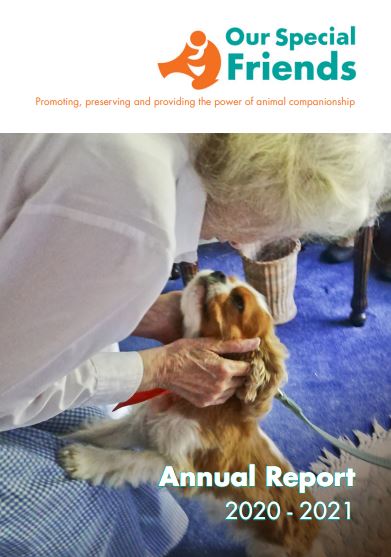
We are delighted to publish our 2020-2021 Annual Report. With special thanks to Max Caine from Caine Design for his splendid pro bono support in designing this fantastic publication for us.

So wonderful to collect a cheque from the Co-op Community Fund!!!

We were delighted to be presented with a cheque for £3,117.86 by Steve Smith and Amy Watson from the Newmarket Co-op branch from members who had chosen to contribute to raise funds for Our Special Friends.

Christine and Griffle help out thanks to Christine’s employer!

In 2017 my little Caitriona was just turning 3yrs old and I was looking to volunteer with her for a fun and worthy cause. I came across OSF on the Volunteer Suffolk website and not long later we were matched with dog walking 3 lovely little ones once per week. A few years passed, with more dog walking and some dog fostering and then Covid-19.

As with many, we didn’t do anything for a while, which I was quite sad about. Also, the difference in Caitriona was not pleasant. She missed her doggy time as much as those we help. Being in a private rented home with a (then) under 6yr old meant that finding a rescue dog suitable for us was very challenging. Then in Feb 2021 a young Lurcher needed a forever home through OSF. We were more than delighted to be contacted and offered this opportunity.

The difference in Caitriona’s mental health over the first month was positive and the continued difference over this first year has been comforting for us parents to see. Our Griffle has made the biggest most positive change for us and has been a joy.

Keeping in touch with OSF, I watch the emails to see when we can help. And although I have done a little dog walking, this years’ Bury Christmas Lights Switch On, presented the chance for Griffle to do her part. Donning her high-vis vest and her pleasant personality, she greeted all with visible and non-visible disabilities. Her calm nature often soothes even the most wary.

And I want to add, this opportunity to attend the lights switch on was supported by my employer. Over the years I have always fit any volunteering around my work. However, in summer 2021 my employer https://www.futuresforyou.com/ announced our Volunteer Policy. The support to attend one full day of volunteering without affecting pay / holidays / sick leave etc. It is a great initiative and one I hope other employers can also offer.

Christina, Caitriona and Griffle.

Volunteer Story – Eva and PERCY

OSF Volunteers, Eva and PERCY

Percy, our 4-year-old cavalier,  just loves attention and cuddles.  He would be quite happy sitting on the sofa all day being cuddled and told how lovely he is.   When out on walks I found we nearly always got stopped and asked for Percy cuddles.  –  Particularly from older people.  I admit, I quite enjoy the warm feeling I get from seeing the joy and huge smiles he brings to people’s faces.   I guess seeing the joy he brings made me want to share him with people more in need and I started looking into volunteering with Percy.  Thankfully, fate had a hand, and I bumped into Belinda Johnston out on a walk at Cavenham,  who suggested we come and volunteer with Our Special Friends.

Percy and I started visiting Gloria at the beginning of August, for an hour on Monday mornings.  Upon our arrival, Gloria is sat in her chair, looking a little agitated and staring blankly at the tv. – I have come to learn that the tv is very often switched off and the house is very quiet.   Gloria is always pleasantly surprised by our visits but each time I have to tell Gloria that we’ve come to see if she’s ok and to see if she would like a cuddle with Percy.   Gloria’s face brightens immediately, insisting we sit down, before rushing off to the kitchen to fill Percy’s bowl with water.  Percy always indulges Gloria by having a drink which always makes her smile and chuckle, telling me that she knew he was thirsty. – I guess Gloria’s nursing instincts of helping others instead of being helped herself is still strong even at the age of 86!

It’s taken Percy a few visits,  (trying each of Gloria’s chairs for comfort, as well as laps,) to finally decide that sitting on the sofa between Gloria and myself is the best place.  However, his favourite position is stretched out on his back, paws in the air enjoying a tummy rub from Gloria.  This is always when Gloria will tell me about her little dog and the mischief he used to get up to.  As well as the amazing stories about her time as a nurse and that her favourite places to work in were Australia and Tazmania.

At the start, I was a little apprehensive about visiting someone with Dementia, worrying about how to make conversation, would they be gentle with Percy or if Percy would even enjoy the experience.    The more that we visit, the more I’ve come to understand that conversation will sometimes flow quite naturally.  On the occasions that it doesn’t it just needs a simple comment about the birds in the garden, asking about one of her photos or commenting on one of the beautifully embroidered cushions Gloria has made.   Sometimes nothing really needs to be said at all, it’s just nice to sit quietly together enjoying cuddles with Percy.  The length of our visit varies from week to week, as they are very much led by Percy and Gloria.  However, I quite often find that the hour goes by very quickly and before I know it, it’s time for us to leave.  It has been an enjoyable experience and its satisfying to know that we are making a positive impact on Gloria’s day and mental wellbeing.  It’s lovely to see Gloria brighten up when we visit.

Just lately I’ve been parking a few streets away from Gloria’s house and walking Percy to her garden gate.  This is partly to give Percy time to wear off some energy after being sat in a car, as well as a chance to for a comfort break.     I’ve noticed that Percy quite happily trots beside me, until we turn the corner and start walking towards Gloria’s house.  Then he’ll start pulling on the lead and seems keen to hurry me along to Gloria’s back door. – I guess it’s safe to say that Percy enjoys the visits too!

Our Special Friends Newsletter October 2021, Issue 13

Welcome to our October Newsletter.
We take pleasure in sharing some of our clients stories. And, we thank some of our volunteers for their moving stories and share in some of the highlights of their volunteering days with Our Special Friends.

Jane tells of her experiences fostering cats for Our Special Friends

Oliver and Storm were my second set of foster cats for Our Special Friends. My own cats had both died a couple of years ago. I decided to foster to keep me company during the pandemic as my partner was away and to help someone else at the same time. I tried local cat charities, but at that time (October 2020) they weren’t looking for fosterers. One charity did sign me up as a volunteer, but all that came of that was I had to complete an online course on data protection for them. I had given up on ever fostering cats when a friend drew my attention to a post on Facebook asking for someone to look after a pair of cats that urgently needed a temporary home. This was because their owner was undergoing a long-term stay in hospital.

Five and a half months later, it was time to return my first fosters to their owner, who had been discharged. We had arranged a date for me to return them, when Belinda asked hesitantly if I could take in another pair whose owner was a victim of domestic abuse. I agreed and – in a miracle of organisation – Lucie, a kind volunteer, drove Oliver and Storm to where the first owner lived. Soon after my first foster cats were reunited with their owner in joyous scenes, Belinda got a text saying that the new fosters had arrived. Lucie handed them over to me in a nearby car park and I drove home with them.

Our Special Friends had arranged for Storm (the black cat) and Oliver (ginger) to be neutered and microchipped by another charity the day before I got them. They were three years old. The neutering and removal to a completely different environment was a considerable shock for them. When I let them out of their carriers, Oliver stayed out, though he was very nervous, and Storm hid immediately behind a big armchair. Storm was to remain behind that armchair for nearly three weeks, coming out for food and water and to use the tray, largely when I wasn’t there. Oliver stayed in a corner of the living room for a few days and then got bolder. I was chatting to my dad on Skype when Oliver first approached me, headbutting me in an affectionate way. My dad said that I looked absolutely delighted. It was even better when Storm started staying out from behind the armchair after so long. He eventually revealed himself to be cuddly lap cat.
Oliver did urinate on working surfaces and in the bathroom after he first arrived, presumably because he was stressed. His urine was very stinky because he was a tomcat that had only recently been neutered. Fortunately, he stopped this after a few days. When they had both settled, they were a pleasure to have around, affectionate and beautiful cats in the prime of life. It’s not just the foster cats who benefit from the fostering arrangements.

Unfortunately, I had to go away at the end of June. Lucie drove over and collected the boys. We really needed her veterinary nurse experience to get them in the carriers. Oliver and Storm were next placed at a local cattery known to Our Special Friends, whose cat accommodation looks palatial in the photographs that I have seen. They spent longer at the cattery than anticipated but have since been very happily reunited with their owner.

I have subsequently taken on a new foster cat, a beautiful long-haired calico, from another case of domestic abuse. Very few charities seem to provide foster-to-reunite homing, which can be very much needed. I am happy to help Our Special Friends offer this service.

Oliver and Storm find respite whilst their owner finds a new home…

Case Summary
This case was referred to us by a social worker having spoken to a couple of national organisations for help and we were recommended to her by Cats Protection. Lucy had fled her home with her child due to domestic violence and needed urgent care for her two (entire) male cats, Oliver and Storm. When the cats arrived at their foster home, they were distressed, hiding away and not using the litter tray.

Intervention – Neutering/veterinary treatment/microchipping/vaccination/fostering/cattery boarding/financial assistance/transport
Within a week of receiving the call, Our Special Friends had arranged for the cats to be neutered, micro-chipped, treated for worms and fleas and a foster home had been found. One of our volunteers collected the cats and arranged for them to be transferred to the foster home in Cambridge. We were fortunate that our (volunteer) fosterer had literally just returned two cats to be reunited with their owner (on discharge from a mental hospital) and was in a position to take on Oliver and Storm. Pet friendly housing had been identified for Lucy so a specific foster period could be agreed.
Unfortunately, the housing was withdrawn due to the perpetrator finding out where she was and Lucy had to be transferred to a Mother and Baby Refuge for up to six months.
The foster care was only available for a limited time period, so it was decided for the welfare of the cats, that they should be looked after in a local cattery known to us.
In order for the cats to move to the cattery they had to be vaccinated (paid for by the RSPCA).
The cats stayed in the foster home for 2½ months and they were in the cattery for 4 months.
After the 6½ months away, the cats were reunited with Lucy and the same volunteer delivered them back to their new home.

Outcome
During the time Oliver and Storm were with our foster carer Jane, she spent an enormous amount of time to help acclimatise them to their new surroundings. They went from showing signs of distress and not using the litter tray, to being calm, playful, relaxed and settled. The evidence of this was recorded by Jane with regular photographs which she shared with Lucy so that she could be reassured by their progress. By the time the cats were sent to the cattery they were much calmer and settled in well. Lucy and her child were thrilled to be reunited and that they did not lose touch with them permanently.

Testimonial:
“When they had both settled, they were a pleasure to have around, affectionate and beautiful cats in the prime of life.  It’s not just the foster cats who benefit from the fostering arrangements.” Jane Skinner (Foster Carer)


My journey to Our Special Friends

Catherine and Edgar’s Story

I had planned to take a short career break, before looking for a new job.  I had worked/studied for 36 years and was really enjoying ‘downtime’ and dare I say it, being a ‘housewife!’  Rosie, my 13y brown Burmese cat also loved having me at home and liked to observe, from her tower, my increased activity in the kitchen!  We had thought about getting another cat for some time and it seemed sensible to get one before I went back to work and Rosie became too old. At the end of February, we collected a chocolate Burmese kitten and named him, Edgar!  Life was a little chaotic trying to introduce Edgar into Rosie’s routine.  Rosie was a formidable character, had run the household for many years and didn’t take kindly to having Edgar bouncing around the place, as if he belonged!

Then the pandemic struck and everything changed.  Two weeks into lockdown one, there was a knock on the front door and when I opened it and saw my neighbours faces, I knew something terrible had happened.  Rosie had been knocked down, and had been left at the side of the road.  She was put to sleep a few days later – we were distraught.  She had become so entwined in our lives and left a huge gaping, hurting hole.  However, Edgar seemed to take everything in his stride and continued being a boisterous kitten!

In April, I was notified that I needed to shield and after careful consideration thought it would be sensible to ‘stay put’, before looking for a new job. As time trundled by, we thought about getting a new companion for Edgar. I contacted Edgar’s breeder (and Rosie’s) and asked if she knew of any Burmese cats that needed a good home.  She said ‘you can have Edgar’s mother!’  I couldn’t believe it!  Cora, arrived in July.

At first the novelty of being a full-time cat mother and housewife was very enjoyable but as time drifted by, I became increasingly bored!  I thought I would start talking ‘CAT’!  After my first vaccination and whilst on a nearby ‘village walk’, I heard about OSF.  When I got home, I googled the charity to find out more and subsequently submitted an application to volunteer.  

Due to my location, it was easier for me to offer a weekly commitment to help in the office rather than drive long distances to help owners and animals in need.  Bin, spoke to me before I started to explain OSF had recently moved their office to new premises and she wanted ‘to manage my expectations.’ I wondered what was in store for me and remember asking if there was a toilet and running water!  Upon arrival I was so surprised to find myself in a bright, spacious, airy office surrounded by fields and beautiful horses.  Certainly, the most picturesque work setting, I have experienced.  

Bil gave me a very warm reception and asked, almost apologetically, if I would clean out the store cupboard and reorganise its contents. I wanted to help the charity succeed and if that meant cleaning a cupboard, then so be it!  Although, I won’t share with you what I found!  Once the cupboard was sorted, I helped Bin pull together some data for the annual report. I also submitted Edgar’s CV to become an animal assisted activity cat – he passed!  Edgar is a young cat, but he is a pretty chilled, laid-back male.  Our first visit was arranged to see a 97y lady who had lived with cats for most of her life but due to her frailty, she could no longer keep one and she missed as she put it ‘a warm body and beating heart’. Edgar and I were accompanied by Gemma to make sure everything went to plan.  As you can see from the photo below, the visit went remarkably well.  Edgar is now on standby for his next assignment!

OSF helped ease me gently back into a work environment, whilst giving me the opportunity to experience the voluntary sector. This week I started a temporary part time job at the Biomedical Campus, Cambridge.  I am also undertaking a short course at the Institute of Continuing Education, whilst continuing to offer support to OSF. Who knows where all this will lead, but I am enjoying building a portfolio of new and different interests!  I am very grateful for OSF helping me to step out of confinement and start living a more ‘normal life’, once more!

Thank you to all our volunteers

Thank you from our Trustees.

Mark, and the trustees, have sent a short video thanking all you wonderful volunteers for your unwavering support. Through a challenging year (or two!), you have all stepped up to the mark and recognised the importance of what we do, more now than ever.

Celebrating some very special Long Service Awards

This month we are celebrating with some of our most longstanding volunteers. Carolyn Bradburne has been with us since inception of the charity contributing to the management of our finances, fundraising and events over the last nine years. Nicola Deery, it seems hard to believe, has been with us for eight years binging with her a wealth of experience from running her own Canine Massage business.

Karen Mallet and Karen Vanner have become integral cogs in the Our Special Friends wheel and have both contributed so much over the five years they have been with us.

Elizabeth Ormerod, has pioneered bond-centred veterinary practice – taking the needs of her clients into account and tailoring treatment plans accordingly. We are immensely grateful for her support as a Trustee for the last three years. We also thank Sarah Louise Noble, Wendy Garner, Wendy Billingham, Karyn Smith, Sally Surr and Ann Abbott for all the support they have given to Our Special Friends over the last two to three years.

We are grateful to you all for your time, expertise and enduring support. We simply could not do this without your contributions.

Current Volunteer Opportunities

We currently have the following Volunteering Opportuntities:

  • Lead Volunteer for both Sudbury and Bury St Edmunds (two roles)
  • Deputy Lead Volunteer for Haverhill
  • Dog Walker – Ixworth
  • Experienced Dog Walker in West Suffolk area
  • IT Technical Support Volunteer (ad hoc)
  • Volunteer Database Support/Administrator


If you are interested in any of the above please do get in touch.

You can also see our Volunteering for Our Special Friends page, where there is a link to download our Volunteer Policy and Volunteer Application Form.

Our Special Friends help to smooth the way

Mental Health Awareness and National Loneliness Awareness Weeks have come and gone but the increasing number of people suffering with their mental health doesn’t go away.

One in four people in this country will experience mental health problems of some kind each year. One is six people will report experiencing common mental health problems like anxiety and depression in any given week. Our physical and mental health are inextricably linked and people living with a long-term physical condition are seven times more likely to experience depression than those without a long-term condition (World Health Survey, 2007). The long term effects of mental ill health can lead to the risk of social isolation, low self-esteem, stigma and discrimination. Without being managed, these can lead to chronic and irreversible conditions; even suicide. We are still living with a huge stigma attached to mental ill health, which considering it has touched many of our lives, is rather difficult to believe.

Our Special Friends believe in the power of animal companionship and we strive to help people who are struggling by offering animal companionship support services. Whether by helping someone maintain contact with their own pet or by introducing a new special friend into their lives. We have the evidence to prove that by doing so, we can provide the vital link which can help them to get through a difficult time.

“Our Special Friends has changed my life. I have improved greatly since receiving their help. They were so understanding and being confined indoors, showed me I was a human being.”

“Our Special Friends played a key part in my welcoming a dog to our home, we having lost ours to a premature death.  She has filled a gap in our lives and is a quiet and gentle new friend to my wife and myself.”

“Our Special Friends reassured me that everything will be ok with my sick two year old companion.  I am an unwell military veteran who relies on my dog for comfort and reassurance as well as safety. I have benefited by Our Special Friends significantly, and I would definitely recommend them to others.”


Please help us continue to help more people like this.

Statistics from the Mental Health Foundation

Bobby loses a quarter of his bodyweight!

Successful weight loss programme is a team effort for Our Special Friends.

Case Summary
This client was referred to Our Special Friends by the local housing association in October 2020 in need of help with her dog and the garden.  Following the death of her Husband some 18 months previously, the dog, a 7 year old entire male yellow Labrador who had been cared for by her Husband, had not been exercised outside the garden, was obese and badly in need of walking.

Intervention
The client and the dog Bobby were both assessed independently by two of the charity’s staff/volunteers: the garden was in need of a lot of work and Bobby was taken out for walks to assess his physical condition.  Early November 2020 Bobby weighed in at 58 kg, which is over 20 kg more than his ideal weight.  He was registered with local vets and his vet records were obtained.  These showed a problem with his breathing (possible laryngeal paralysis), which was exacerbated by being overweight.

Working with vets, a weight management and exercise plan was devised for the dog and then a volunteer dog-walking group was set up. The programme included Royal Canin Satiety diet. His exercise regime had to be built up slowly, to avoid injury, but after not being out for so long, he was very excited to be walking again and was very strong and pulled terribly on the lead.  Walks by volunteers were set up on a rota for 4 or 5 times a week. Our Special Friends donated a Pitpat activity monitor which fits on to Bobby’s collar; this measures how far he walks, calories used etc. (a canine Fitbit).

Bobby had a visit from a dog trainer (one of our volunteers), who provided a Gentle Leader halter to help stop him pulling. Our Special Friends provided a leather lead to use with the halter and this works well.  The charity also donated several packs of Burns organic dog meat, plus poo bags.

Outcome
In January 2021, it was noticed that Bobby was not moving well and vet checks revealed onset of arthritis, so Yumove tablets were administered and exercise walks limited to approx. half an hour each walk.  He was still very excited to be going out, and walks much better now and is quite manageable.

Volunteers kept images of his faeces to check all is well; a problem occurred in March, when he had bad diarrhoea and was suffering from gastro enteritis; taken to vets by volunteers and treatment of electrolytes and probiotics prescribed.

The weight loss management went very well; combination of correct feeding and exercise programme has resulted in a total weight loss of 13.6 kg by April 2021, when he weighed in at 44.4 kg.  Weight loss has levelled off, but regime is being maintained by continuing with the diet and exercise being kept up.

Visits to vets were co-ordinated by volunteers; he was found to have a heavy flea burden in November, so treatment prescribed, together with thorough de-flea of house and bedding to prevent re-infestation.  A worming treatment was also administered. Visits to the local grooming parlour were organised for shampoo, groom and nail trim; again, all arranged by our volunteers.

The diet and walking routine has obviously proved to help Bobby with his weight loss and he is now a much healthier dog. Whilst the voluntary dog walking 4 or 5 days per week, this is not sustainable in the long-term. A continuing arrangement is being discussed with the family so that the walks can be maintained whilst our client continues to follow the advice of the Royal Canin diet plan.

Client Testimonial
“Bobby was our fathers Dog, helping to keep Dad active, with Dad’s declining health before his passing, Bob was losing out on his exercise, Mum wasn’t able to walk far so Bob’s routine changed considerably.

What with having to look after Mum preceding Dad’s passing, Bob got left behind somewhat but was always good company for Mum. Bob however was starting to feel the weight of Mum’s affection and something clearly had to be done.

In stepped Our Special Friends who have been quite amazing, not only for the volunteer walkers but the diet and vet advice that have got on top of his health and weight. Bobby looks and acts much better now and looks forward, with excitement, to his new friends that come to walk him.

Our Special Friends and the volunteer walkers have not only changed Bob’s life for the better but allow us the time to look after Mum. Our thanks go out to everyone concerned who work so hard and do such a good job from Our Special Friends, you know who you are, we appreciate everything you do. 

Thank you.” 

It’s a Sniffari! (Part 2)

What to do when you can’t exercise the dog

Provide environmental enrichment with Snuffle mats, Lick mats, Food Puzzles and simple tricks to encourage engagement. The goal will be having the dog work/hunt for most of their food which is closer to a natural lifestyle rather than the free bowl of food. This requires more planning but the dog benefits 10-fold from the new routine.

Simple Rules

If possible have a chat beforehand with the owner and ask about the dog and find out what their normal routine is. To begin you will want to stick as closely to the normal routine as you can, then you can slowly introduce change. Ask the owner what they are expecting, some are happy and trusting and others are a little more emotionally attached to their pet and feel guilty not being able to provide the care they did before.

Ask if the dog experiences any problems with other dogs while on lead. These dogs tend to be called lead aggressive, fearful or stressed but are actually just Reactive dogs and require sensitive handling. Always stay in your comfort zone and don’t feel obliged to walk dogs that may be difficult on the lead with other dogs. The same rule applies if you are uncomfortable/unfamiliar with using a muzzle, large heavy dogs or walking alone in remote areas.


It is very important to know if there are any medical conditions that may require you to adjust your plans for walking. For example, best not to go on a long remote walk with a dog with a history of seizures/epilepsy especially if it’s a large dog that will be too heavy for you to carry comfortably over distance.

One of the most common medical issues is arthritis and not just in old dogs, many are undiagnosed and due to the mechanism of the condition it tends to manifest the day after a walk when the dog becomes painful and can be mistaken for just being tired and stiff. In general, it’s best to exercise in short frequent sessions, so for the older or arthritic dogs keep the walks to under 30 mins. The dog will be more comfortable with multiple shorter walks rather than a single long walk.

This is a good time to mention some common practices that are now considered bad for joint health and cause repetitive strain injury. Dogs can easily become obsessive with having the ball thrown but this can cause joint and ligament damage so the new recommendations are to restrict throwing the ball to just a few minutes and to not throw far. The damage occurs when the dog chases the ball long enough to gain speed and then has to de-accelerate suddenly. An alternative to those plastic ball throwers would be a Frisbee and because the direction of the flight is curved it reduces the fast-deceleration phase.

Another habit that can cause injury is throwing sticks, it is now recommended not to throw any kind of stick you find on your walk because they can splinter and cause injury to the mouth, be inhaled and be life threatening and there have been serious accidents where the dog has been impaled on the stick.

Check with the owner for any food allergies, having treats available when walking is a great way to get the attention of a reactive dog or as an aid to training but make sure they are safe beforehand and use them sparingly to prevent diarrhea or GI upset later. Treats tend to be very high in calories and fats so please ensure the dog has no history of Pancreatitis, Diabetes, IBD or is overweight.

Plan your walk to fit the dog’s requirements and the facilities available. Practice fitting harness/head collar beforehand and become familiar with the many different makes and models. The harness must be firm enough to prevent the dog from escaping backwards. Remember you are responsible for the safety of the dog so feel free to make adjustments and make sure the equipment is safe and suitable, we do not recommend using choke collars, pinch collars or retractable leads.

If you have a dog that pulls excessively, changing to a harness where the lead attaches at the front or using a halti-collar may help but first discuss with the owner before changing the dog’s equipment and only use it if you are confident using the product.

Check that the dog has a name tag on the collar or harness, this a legal requirement for all dogs not on their own property. During the winter months, make sure you have a torch or light on the dog’s collar and Hi-Viz jacket.

Plan for enough time once you have finished the walk to towel dry the dog or wipe mud/salt from their feet and do a quick Tick check.

In Hot weather, check the temperature of the pavement with your hand and try to walk on grass which is always cooler.

Never leave a hot panting dog without ensuring they have access to water and cool shade. The Brachycephalic/short nosed dogs such as bulldogs, Frenchie’s, Pugs and Pekinese may require artificial cooling with a fan if the ambient temperature is warm. Remember the main cooling mechanism for the dog is evaporation from panting, this is a slow process and completely ineffective for these types of dogs as their ability to breath is severely restricted by the shortened snout. It is safer to walk these breeds during the cooler mornings or evening and even then, you should keep the walks short and slow. During hot weather it may be best to not walk at all.

For beach walks it’s very important to offer fresh water even if the dog has not entered the sea as the sand is just as salty and easily blown into their mouths on windy days. Do not throw balls into the sea as this allows the dogs to ingest an abnormal amount of saltwater which can cause vomiting and possibly more serious harm. It’s good practice to rinse the dog in fresh water after a beach walk to remove any salt which they may later ingest when grooming themselves.

For female dogs you suspect that might be in heat and you are unable to walk in a secluded area. It may be safest to not walk the dog at all for a few days because it can be very dangerous if you are approached by unleashed male dogs.

If you need to drive to a suitable place to walk, please be aware it is now Law to secure the dogs in the car either with a dog harness/seatbelt, in a secure crate or behind a barrier in the back of a hatchback. Carry a towel to dry the dog and protect your seats and provide freshwater + bowl.

Practice good biosecurity and wash boots after walks especially if visiting different places.

It is always good practice to avoid walking on any playing fields or areas close to children’s play equipment and always attach a lead when walking on public highways or crossing the road.

Always leave an itinerary and contact info. Have your phone with you and have the number and address of the veterinarian in case of emergency. Have the owner inform the vets office that you have the owner’s permission to bring the dog in if needed.

It’s a good idea to download the “What 3 Words” app. This will give your exact location for the emergency services.

https://what3words.com/products/what3words-app/

Mental Health Awareness Week, ever more poignant for Our Special Friends

At Our Special Friends, we recognise the support that animal companionship can bring to alleviate the burden when one is feeling stressed, upset or alone. What do they say? ‘A problem shared is a problem halved.’

There are times in all our lives when things can feel a bit too much. It can be stress at work or worries about our family or our health. It can be feeling lonely. Sometimes it is difficult to know where to turn to receive the help that you need and the problem escalates. There are simple things we can do to support our mental health.

Being able to talk to an animal has a restorative effect on our wellbeing. We are encouraged to get outside into the fresh air. Even if you don’t have a pet, you can enjoy the company of animals on a walk, or maybe you can sit and enjoy the birdsong in the garden. Some of us are lucky enough to live in the countryside and just seeing a deer or pheasant, listen to the skylarks or hear the bark of a muntjac can lift the spirits on an evening stroll and add so much pleasure to being outside.

But sometimes this is not so easy. It might be that you can’t get outside. You may be frail or housebound or feel unable to go out alone. Our Special Friends is here to help people cope when they do not have an animal of their own or maybe they are struggling to look after their own pets for health reasons. We help to find a solution to the problem so that the pressure is eased and the worry subsides and we enable them to get the help that they need.

Mental Health Awareness Week for me, is a reminder that we should all be conscious of one another’s vulnerabilities. Perhaps to take some time out and check on your neighbours, elderly relatives or youngsters who may also be having a tough time at school. It doesn’t have to be Mental Health Awareness Week to ask, ‘Are you alright?’ every now and again.
For more information on Mental Health Awareness Week and for resources that can help visit Our Special Friends Resources.

On The Topic: Mental Wellbeing